Bridging clinical nephrology, non-invasive biosensors, predictive artificial intelligence, and mobile health software to make precision renal care universally accessible.
Dietary salt excess is the silent catalyst of hypertension, stroke, and progressive end-stage kidney failure. Until now, accurate 24-hour sodium monitoring required cumbersome all-day urine collections that over 80% of patients failed to complete accurately.
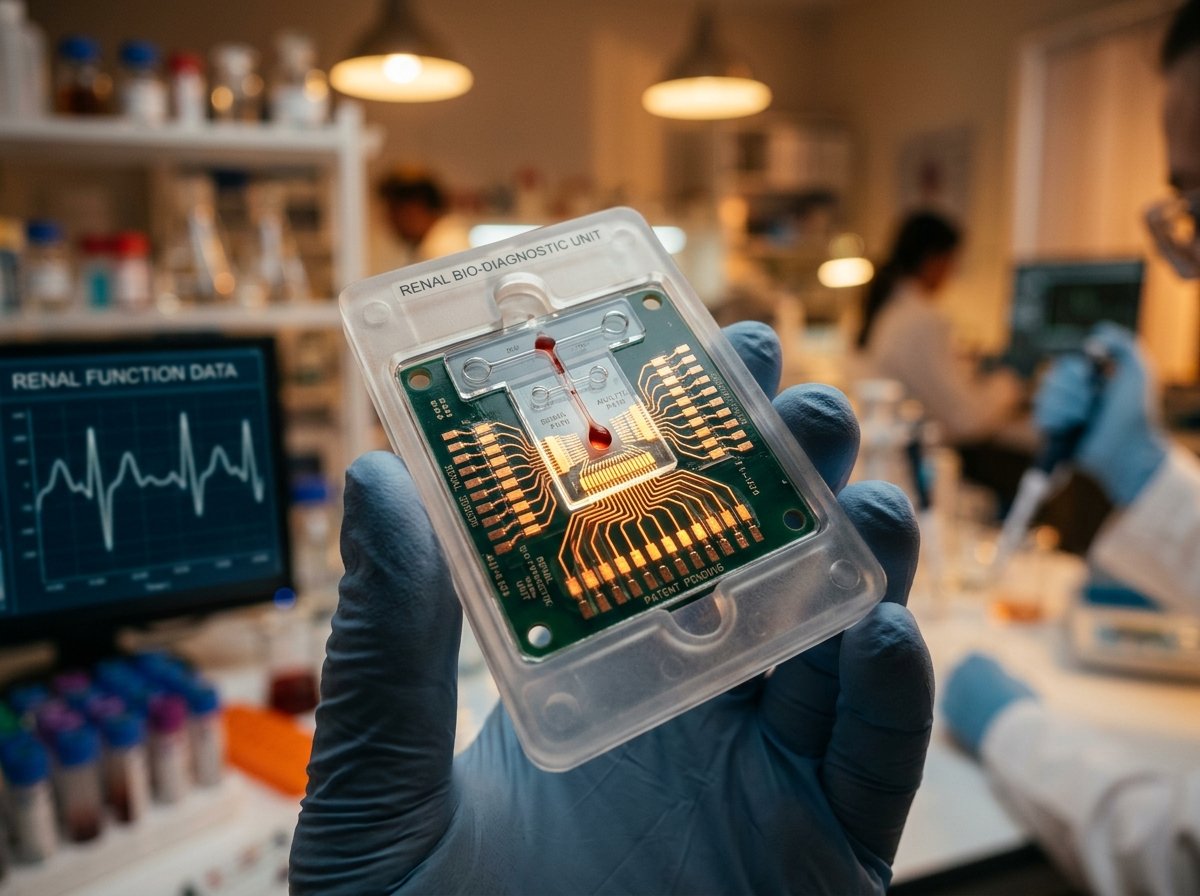
Dr. Ilangovan engineered a microfluidic biosensor coupled with mathematical algorithms that calculates true 24-hour sodium excretion from a single, instant spot urine test. This invention won the prestigious TANKER Award from the Indian Society of Nephrology and was officially granted an Indian Patent in 2026.
Deploying software algorithms, mobile health applications, and clinical predictive models to empower patients and assist kidney clinicians.
Launched on World Kidney Day (March 13, 2025), this personalized Android application dynamically computes kidney-safe culinary choices based on stage of CKD, eGFR, potassium, acidosis, and diabetes.
A comprehensive web decision-support system built to streamline pre-transplant donor-recipient immunological workup, HLA antibody risk stratification, and desensitization protocol design.
Developed in collaboration with IIIT Bangalore, this machine learning algorithm accurately flags asymptomatic urinary tract infections in high-risk pregnant women using basic routine test variables.
Rigorous clinical trials, randomized controlled studies, and peer-reviewed nephrology papers published across leading international journals.
Saxena A, Srinivasa S, Veerappan I, Jacob C, Mahaldar A, Gupta A, et al. Nutrients. 2022; 14(18): 3804.
Veerappan I, Chandel V, Sethuraman R. Kidney Int Rep. 2020; 5(3): S304.
Veerappan I, Thiruvenkadam G, Abraham G, Dasari BR, Rajagopal A. Indian J Nephrol. 2019; 29(5): 317-23.
Selva Kumar SS, Veerappan I, Sethuraman R, Chakravarthy T, et al. Indian J Transplant. 2022.
Bhuwania P, Veerappan I, Sethuraman R, Rajgopal A. Ther Apher Dial. 2022; 26(2): 398-408.